


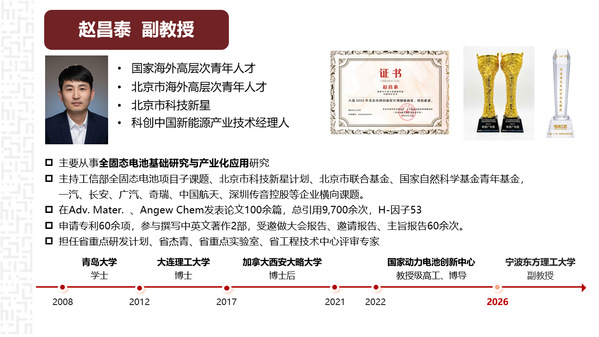
Changtai Zhao, an expert in the field of all-solid-state batteries, has recently joined the School of Materials Science and Engineering at Ningbo Eastern Institute of Technology on a full-time basis, appointed as Associate Professor and doctoral supervisor. With his arrival, EIT's positioning in new-energy materials is strengthened by a young scholar who combines academic depth with industry experience.
From Dalian to North America, and Then to the Front Line of the Battery Industry
In 2017, Changtai Zhao received his Ph.D. in Chemical Technology. He then went to the University of Western Ontario in Canada for postdoctoral research, focusing on all-solid-state batteries. After returning to China in 2022, he joined China Automotive Battery Research Institute Co., Ltd. / GRINM (Guangdong) Advanced Materials Technology Research Institute as a Professor-level Senior Engineer and doctoral supervisor, moving to the front line of battery engineering.
This industrial experience has strongly shaped his academic career. In 2023, he completed the development of a 350 Wh/kg-class all-solid-state pouch cell; in 2024, he built China's first 0.1 GWh-class pilot line for dry-electrode processing of all-solid-state batteries, and in the same year completed a 10 Ah-class halide all-solid-state pouch cell with an energy density of 380 Wh/kg; in 2025, all-solid-state battery samples completed application verification in lithography equipment inspection systems; in 2026, the world's first all-solid-state battery concept smartphone completed verification and was unveiled.
All-solid-state batteries sit at the intersection of the academic frontier and the industrial frontier. The key is to solve the real problems in industry. Changtai Zhao's research orientation has always been clear — application-driven, translating research results all the way into products.
Balancing Publications and Patents, with Projects Covering Multiple Automakers
Changtai Zhao's research areas include the development of key common technologies for solid-state batteries, safety control and failure mechanisms of all-solid-state pouch cells, new-system solid-state batteries, and industrialization technologies for lithium-ion batteries. He has published more than 100 papers on all-solid-state batteries in journals such as Angewandte Chemie and Advanced Materials, with over 9,700 cumulative citations; he has filed more than 60 patent applications, with 20 of them granted, and has co-edited 2 books in Chinese and English.
In terms of research projects, he has led sub-topics under a major special project of the Ministry of Industry and Information Technology, and has led projects funded by the Beijing Nova Program, the Beijing Joint Fund, and the NSFC Young Scientists Fund; he has also undertaken industry-funded projects for companies including FAW, Changan, GAC, Chery, China Aerospace, and Shenzhen Transsion Holdings. In terms of talent programs, he has been selected for the National Special Program for Overseas High-Caliber Youth Talents, Beijing's Haiju Program, and the Beijing Nova Program. In academic service, he serves as a new-energy industry technology manager for China Science and Technology Innovation (CSCA), participated in compiling the Roadmap for New Energy Storage Technologies, and sits on the early-career editorial boards of journals including eScience, Rare Metals, and JMST.
Why He Chose EIT
Speaking about his reasons for joining, Changtai Zhao mentioned two points: first, the university's research model — combining interdisciplinary integration, free exploration, and responsiveness to industrial needs — matches his long-standing commitment to application-oriented research; second, the university grants research teams considerable autonomy in talent recruitment, resource allocation, and commercialization of research outcomes.
Ningbo is a major hub for the new-energy industry in the Yangtze River Delta region, with strong integration between its industrial and innovation chains. Changtai Zhao believes that by closely connecting frontier international research with Ningbo's industry, EIT's materials discipline is well positioned to become an important pivot for regional science and technology innovation.