


On March 4, Xueliang Sun, University Chair Professor at Ningbo Eastern Institute of Technology and Foreign Member of the Chinese Academy of Engineering, visited Dongnan Primary School in Yinzhou District, Ningbo, delivering the 22nd lecture of the series 'Scientists Take the Stage', titled 'Small Battery, Big Dream: Lighting Up the Future of a Strong Nation with China's Own 'Chip''. The lecture also served as the first science-education class of the new semester in Yinzhou District.
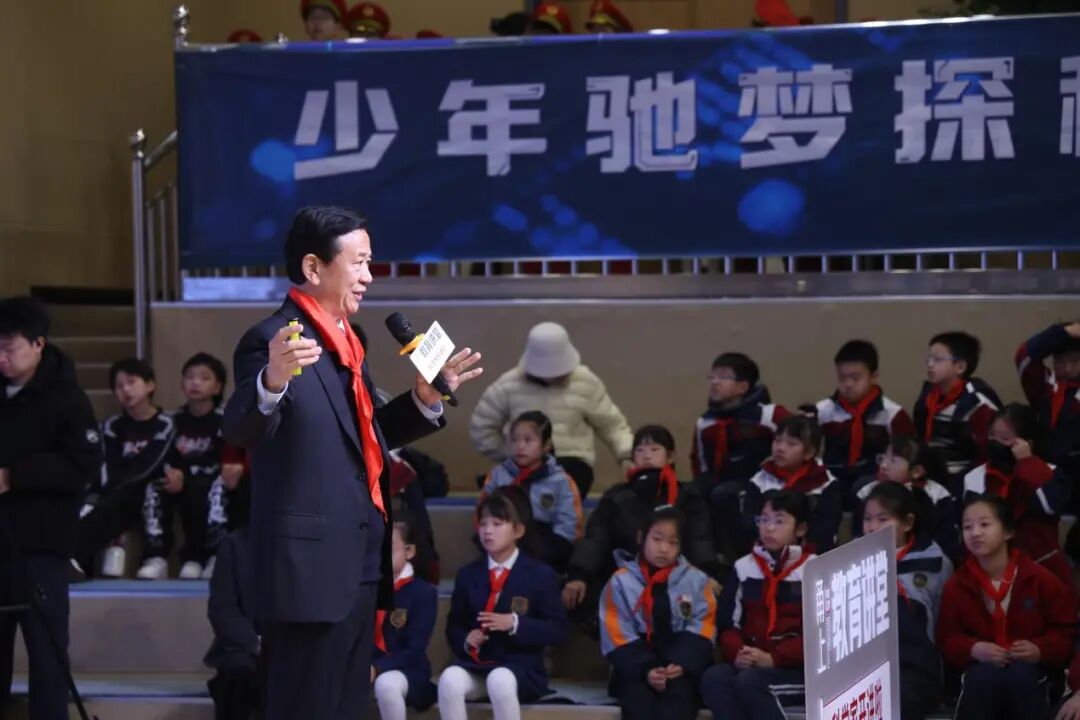
Photo caption: Xueliang Sun faces the pupils.
Sharing His 'Childhood' in Public for the First Time
'I'd like to tell you about my path of growth. This is also the first time I share stories about my childhood in public.' On the big screen, a black-and-white photograph from half a century ago carried the children back to that era: it showed the rural primary-school classroom where Sun studied in Grade 5 — the legs of the desks were bricks stacked with cement, and the desktop was nothing but a rough, thick plank.
Sun was born in Tianjin. As his parents were busy with work, he grew up from childhood with his grandparents in the countryside. 'The hardships of rural life tempered my will and played a major role in my later life. Even after I went abroad, every time I returned to China I would go back to the countryside for a look and take a walk through the fields — that is where I grew up.'
Later he was admitted to a key secondary school in Tianjin, which eventually gave him the chance to enter university. 'Back then, the university admission rate was only 3%. I am grateful for the country's reform and opening-up, which gave me the opportunity to attend university. Once I had achieved something abroad, I wanted to come home and contribute.'
Sun has long been devoted to the development of new materials and electrochemical energy systems, with research spanning basic science, applied technology, and clean-energy engineering. In 2023, he returned to China to join Ningbo Eastern Institute of Technology as University Chair Professor and Director of the Institute of Matter and Energy.
Sun has so far supervised 140 doctoral and master's students, 70% of whom are Chinese, and more than 70 of them have already returned to work in China. 'For us researchers, there is another thing we are especially proud of: cultivating students. At Ningbo Eastern Institute of Technology, the excellent research environment allows me to lead students and use the new-energy track to develop young talents' research capabilities.'
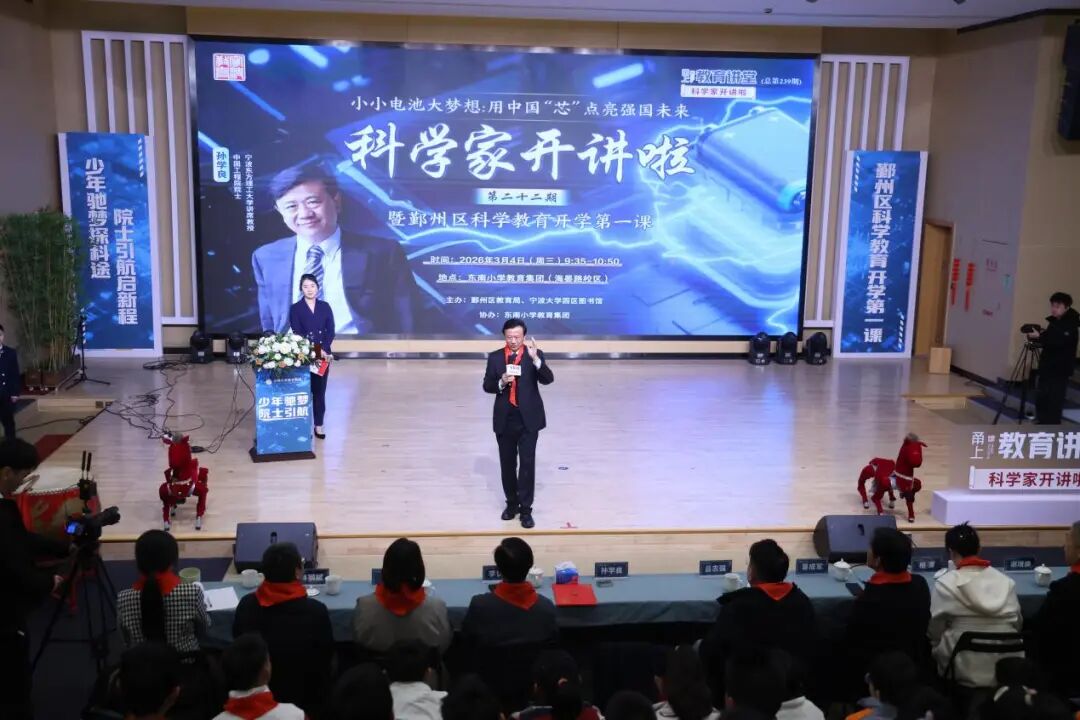
Photo caption: The lecture site of 'Scientists Take the Stage'.
A Nobel Laureate's Question Inspires the Pupils
'In the next fifty years, what ten major problems will humanity face? Would anyone like to answer?' At the start of the lecture, Sun posed the famous 'Smalley Question', named after Nobel laureate in Chemistry Richard Smalley.
'Air pollution', 'war', 'melting glaciers', 'energy consumption'... The children's eager answers made him instinctively give a thumbs-up: 'Your answers match the actual top-ten list remarkably well, showing a very high level of scientific literacy. Thumbs up for all of you!'
When the answers were revealed, 'energy' ranked first among the ten major problems. Sun used this to introduce China's energy situation and national strategy. 'More than 70% of the total oil consumed in China every year is imported. In the past we all drove fuel cars; now our country is moving toward new-energy vehicles. We are changing our dependence on oil — we are developing an 'Electric China'.'
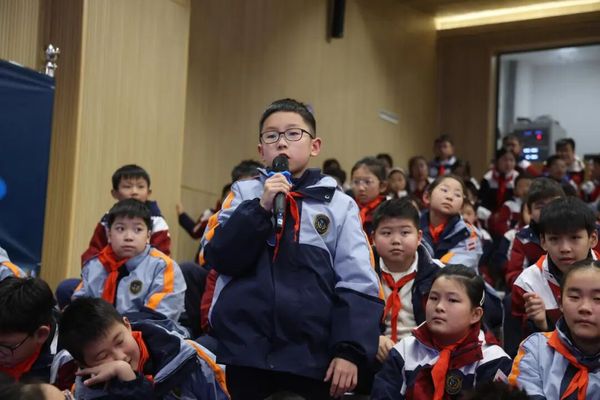
Photo caption: Interacting with the pupils.
He spoke from the development trends of new energy all the way to the power batteries and hydrogen fuel cells he is currently researching.
Sun told the children that in the future there will not only be more and more electric cars and electric trains, but also electric airplanes. At the end of the lecture, he left the children with three sentences:
'Always stay curious — curiosity is the engine that explores the world.'
'Don't be afraid of making mistakes — every fall is an upgrade for your brain.'
'Keep your feet on the ground — even the most distant dream begins with writing every character well and solving every problem correctly.'