


Cation-disordered rocksalt (DRX) cathode materials offer high capacity and a vast compositional design space, and can reduce dependence on scarce metals such as nickel and cobalt, making them important candidate materials for next-generation high-specific-energy lithium-ion batteries. However, identifying effective lithium-ion migration pathways within complex disordered structures and screening new compositions accordingly remains a difficulty in materials design. Traditional theory usually treats the lattice as an ideal, static skeleton, judging lithium transport capability solely from the distribution of cations in local channels, and therefore often underestimates the capacity a material can actually deliver.
Recently, the team led by Academician Xueliang Sun, Shuo Wang and Jian Peng from EIT - Eastern Institute of Technology, Ningbo collaborated with the research group of Professor Qiang Sun from Peking University. By integrating knowledge of ion transport with AI-accelerated atomic simulations, the team uncovered the microscopic mechanism through which lattice distortion and cation disorder synergistically regulate lithium-ion transport. Based on these findings, the researchers established a computational framework capable of quantitatively predicting lithium-ion percolation networks and electrochemical capacity. The capacity prediction of new multi-cation cathodes was validated via compositional screening, targeted synthesis and electrochemical measurements. This study demonstrates a research workflow that defines design principles based on physicochemical mechanisms, performs quantitative calculations with AI tools, and verifies material designs through experiments. The related results were published in the Journal of the American Chemical Society under the title Interplay of Lattice Distortion and Cation Disorder Governs Li-Ion Transport in Cation-Disordered Rocksalt Cathodes.
Key Innovations
Revealing How Lattice Distortion Activates New Channels, Starting from Transport Mechanism
In disordered-rocksalt cathodes, lithium-ion transport must pass through local tetrahedral sites. According to the conventional "0-TM" rule, only channels with no neighbouring transition-metal cations can effectively transport lithium ions, whereas "1-TM" channels containing one transition metal are usually regarded as blocked.
Real lattices, however, are not static. Differences in size and chemistry among cations cause local lattice distortion, which can alter lithium migration barriers and turn some originally blocked 1-TM channels into passable routes. For example, in Mn-containing 1-TM channels, as the local tetrahedron distorts, the lithium migration energy barrier can drop from 0.67 eV to 0.31 eV.
More importantly, 1-TM channels also act as "bridges" in lithium transport. Some 0-TM clusters capable of lithium conduction are isolated from one another and struggle to form a percolation network spanning the crystal. The 1-TM channels activated by lattice distortion can connect these clusters, allowing lithium ions to transport over a wider range. This mechanism links local structural change to macroscopically available capacity, and provides a basis for regulating ionic transport through compositional design.
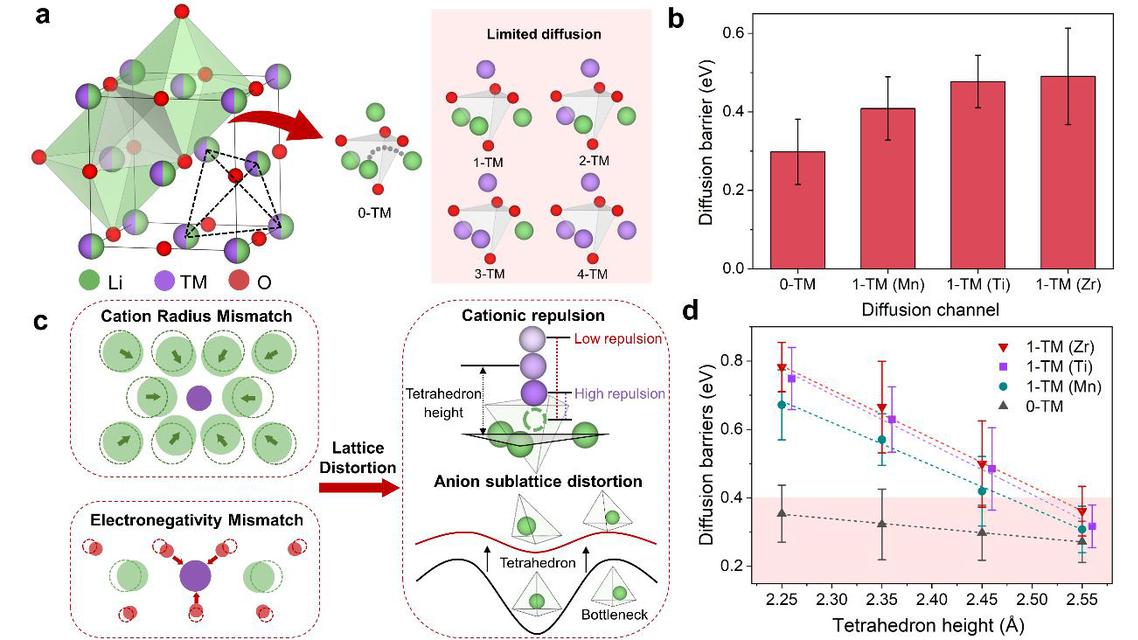
Figure 1. Schematic of lithium migration barrier modulation by lattice distortion.
AI-Accelerated Simulation Achieving Quantitative Capacity Prediction
To apply the above mechanism to materials design requires simultaneously describing how cations arrange, how atoms deviate from the ideal lattice, and how these changes affect channel connectivity. To this end, the team adopted the graph-neural-network interatomic potential CHGNet and, using structure-relaxation data from first-principles calculations, fine-tuned it separately for the two reference materials and the target new material to obtain machine-learning interatomic potentials suited to each system. Such AI models learn the relationship between atomic structure and energy/forces, accelerating the energy and force computations required for repeated sampling. The team then carried out hybrid Monte Carlo and molecular dynamics simulations: the former samples cation arrangements, the latter introduces local lattice response, thereby considering configurational disorder and lattice distortion within one framework.
Domain knowledge further determined how to convert simulated structures into testable performance predictions. Through first-principles migration-barrier calculations, the team established a criterion linking local tetrahedral geometry to channel passability, identified the 1-TM channels activated by distortion, and built the lithium-ion percolation network together with the 0-TM channels. AI interatomic potentials provide the energy and force computations, while transport mechanism and connectivity analysis convert atomic-scale information into the fraction of transport-capable lithium and capacity predictions.
Taking two typical DRX cathodes as examples, the model predicts the fractions of lithium participating in the percolation network in Li₁.₂Mn₀.₄Zr₀.₄O₂ and Li₁.₂Mn₀.₄Ti₀.₄O₂ to be 41.6% and 65.2% respectively; the corresponding predicted capacities are 135.5 and 257.5 mAh g⁻¹, with relative deviations from the experimental values of 141.3 and 260.0 mAh g⁻¹ both below 5%. This result supports including distortion-activated 1-TM channels in percolation analysis, and shows that AI-accelerated simulation combined with transport mechanism can improve the quantitative description of a material's available capacity.
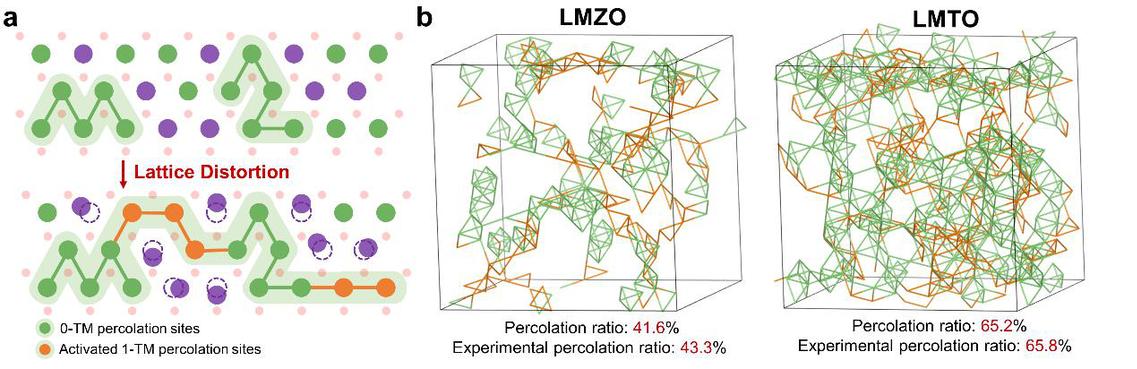
Figure 2. Effect of introducing lattice distortion on the percolation network and capacity-prediction comparison.
Mechanism-Guided Compositional Screening; Experiment Verifies New-Material Prediction
Based on the insight that lattice distortion can activate migration channels, the team used a multi-cation strategy to tune the local chemical environment and, building on the known DRX material Li₁.₂Mn₀.₄Ti₀.₄O₂, constructed 289 candidate structures comprising all pairwise combinations of 17 transition metals. The study first calculated the mixing temperature of candidates to qualitatively compare the difficulty of forming disordered solid solutions; Li₁.₂Mn₀.₂Ti₀.₂V₀.₂Mo₀.₂O₂, containing V and Mo, performed best on this metric and was selected as the target for further study. This step linked the compositional design direction proposed by the mechanism with synthesizability assessment, fixing concrete targets for subsequent AI-accelerated simulation and experimental preparation.
The team then used the target-composition-fine-tuned AI interatomic potential to carry out hybrid simulation and percolation analysis. Results show that after introducing V and Mo, the average transition-metal displacement increased from 0.20 Å in the reference material to 0.27 Å, cation short-range order weakened, more 1-TM channels were activated, and the lithium percolation fraction rose from 65.2% to 71.6%, with a corresponding predicted capacity of 255.1 mAh g⁻¹. The selection of candidate composition thereby gained quantitative basis among local structure, transport network, and capacity.
Under computational guidance, the team successfully synthesized the material by a one-step room-temperature mechanochemical method. Experiments show that in a voltage window of 1.5–4.7 V at a current density of 10 mA g⁻¹, the first discharge specific capacity reached 256.3 mAh g⁻¹, differing from the theoretically predicted 255.1 mAh g⁻¹ by about 0.5%. Synchrotron X-ray diffraction confirmed the single-phase disordered-rocksalt structure; elemental distribution characterization showed uniform distribution of all components; and X-ray absorption spectroscopy further provided evidence for the participation of multiple transition metals in redox. The synthesis and electrochemical results jointly verified the mechanism-guided materials design and its capacity prediction.
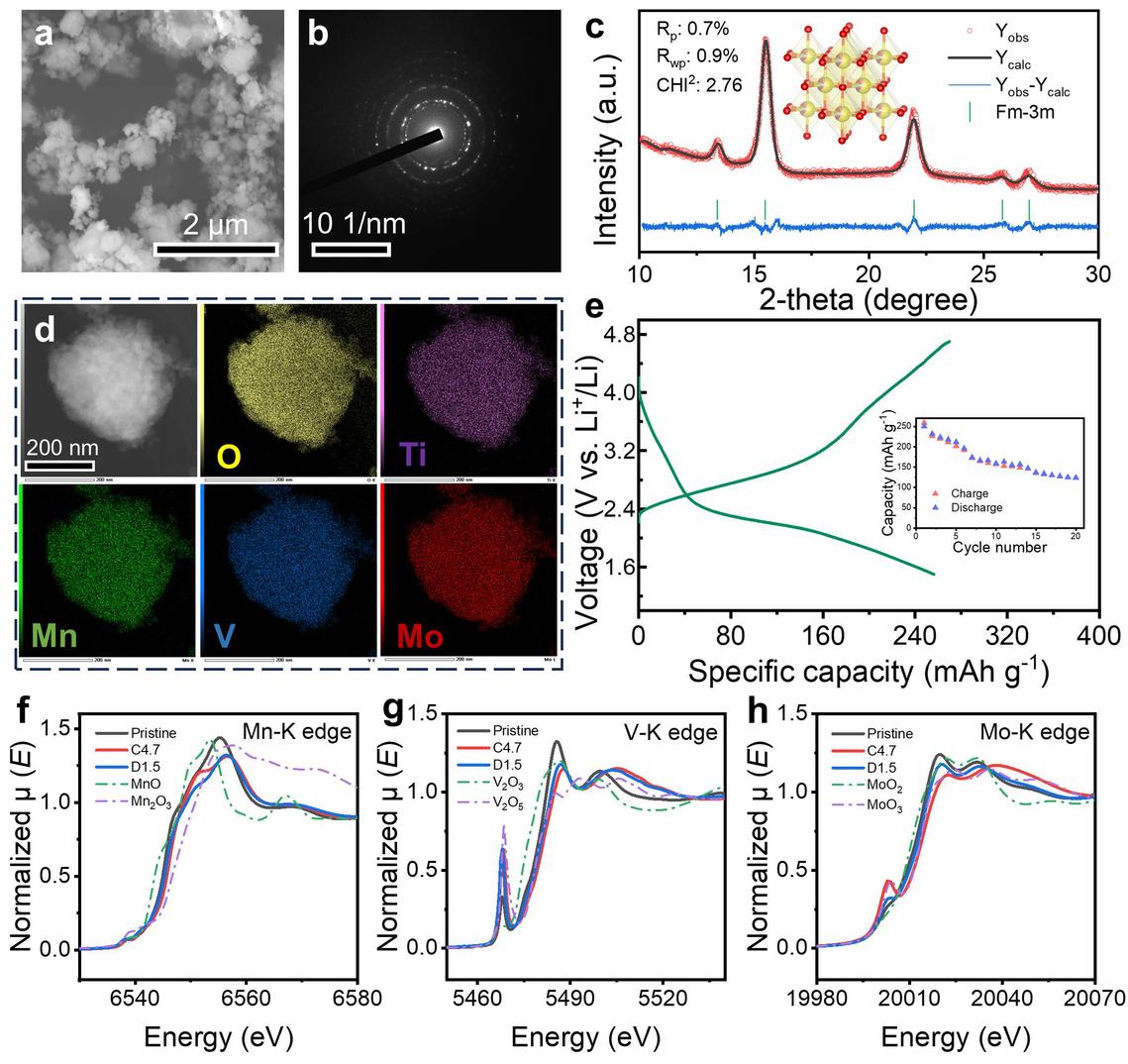
Figure 3. Synthesis and electrochemical performance verification of the cathode material obtained by computational screening.
This study shows that improving ionic transport requires a balance between channel activation and structural stability. Moderate distortion can open new migration paths and suppress short-range order, while excessive distortion may cause large transition-metal migration and structural destabilization. For the systems studied, based on molecular dynamics analysis the team proposes an optimized range of average transition-metal displacement of about 0.3–0.4 Å, providing computational reference for further exploring compositions that combine lithium migration capability with structural stability.
This achievement establishes the link among "local chemistry — lattice response — configurational disorder — ionic transport", and clarifies the complementary role of domain knowledge and AI tools in materials design: researchers determine the candidate space and channel criteria based on physicochemical mechanism, AI interatomic potentials accelerate sampling of complex disordered structures, percolation analysis gives capacity prediction, and experimental synthesis and testing verify the predictions. This research path provides an example of mechanism-driven targeted materials screening and is expected to offer new ideas for the rational design of sodium-ion conductors, oxygen-ion conductors, mixed-anion solids and other materials.
Zhang Zichang of Peking University and Feng Lihua of Ningbo Eastern Institute of Technology are the co-first authors of the paper; Wang Shuo and Peng Jian of EIT and Sun Qiang of Peking University are the corresponding authors. The work was supported by the National Key R&D Program of China, the National Natural Science Foundation of China and other projects, and was carried out on EIT's high-performance computing platform and at beamlines of the High Energy Photon Source and the Shanghai Synchrotron Radiation Facility.
Related paper information
Title: Interplay of Lattice Distortion and Cation Disorder Governs Li-Ion Transport in Cation-Disordered Rocksalt Cathodes
Journal: Journal of the American Chemical Society
Link: https://doi.org/10.1021/jacs.6c05378.s001