


Phones that die too soon, EVs that can't go far enough, energy-storage stations afraid of fire — behind these pain points lies the same goal: building safer, higher-capacity next-generation batteries. All-solid-state batteries, with their high safety and high energy density, are regarded as a key direction for next-generation energy-storage devices. Halide solid-state electrolytes combine high ionic conductivity with good cathode compatibility and have become a research hotspot in recent years; however, they suffer from poor air stability and severe interfacial oxidation at high voltage, and conventional stabilization strategies often sacrifice ionic transport.
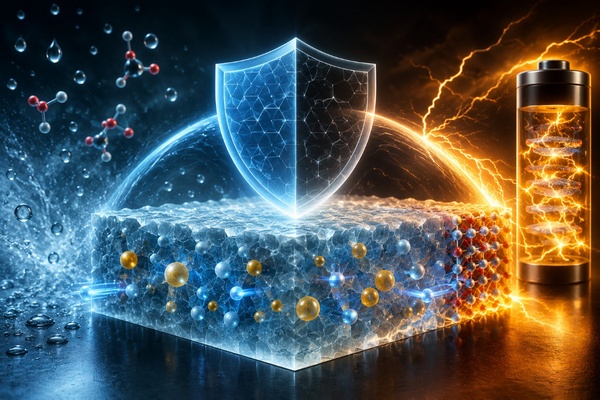
Image caption: Ionic conductivity vs. stability — the "fish-and-bear's-paw" dilemma of halide electrolytes.
Drawing inspiration from "additive engineering" in liquid batteries, the team of Sun Xueliang — University Chair Professor at Ningbo Eastern Institute of Technology (EIT) and Foreign Member of the Chinese Academy of Engineering — and Assistant Professor Xia Wei proposed a "solid additive" strategy: inexpensive, lithium-free metal oxide nanoparticles such as Al₂O₃ are introduced directly into the mechanochemical synthesis of halide electrolytes. The related results were recently published in Angewandte Chemie International Edition.
From Liquid Additives to Solid Additives: A Wholly New Electrolyte Design Philosophy
In liquid batteries, functional additives can tune local chemical environments and interfacial reactions, improving both cycling stability and safety. Inspired by this, the team asked a key question: can the concept of "additive engineering" be extended to solid electrolytes? Following this idea, they introduced metal oxide nanoparticles such as Al₂O₃ directly into the mechanochemical synthesis of halide electrolytes. The study found that oxide additives are not inert fillers; they work through a synergistic mechanism of "partially participating in reconstruction, partially remaining stable".
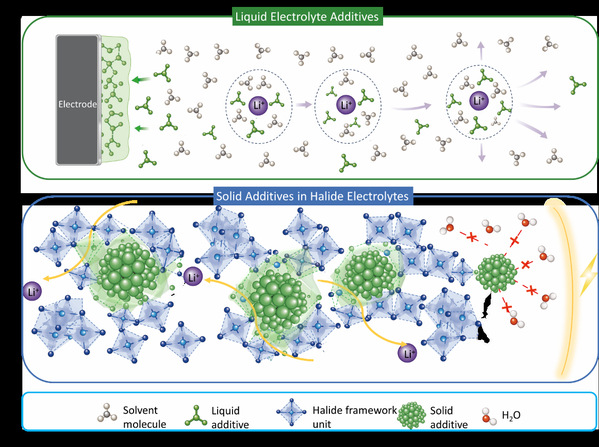
Image caption: Liquid additive strategy vs. solid additive strategy. Image courtesy of the research group.
"Partly Promoting Transport, Partly Preserving Stability"
Using the Li–Zr–O–Cl system as a model material, the team systematically studied the structural evolution, ionic transport behavior, and chemical stability after introducing oxide additives. During the mechanochemical process, part of the Al₂O₃ undergoes local coordination reconstruction with the halide framework, forming a more disordered local environment favorable to Li⁺ migration and thereby promoting ionic transport — the room-temperature ionic conductivity rises from 1.71 mS cm⁻¹ to about 2.3 mS cm⁻¹. Meanwhile, the Al₂O₃ that does not fully react remains as stable nanostructural domains that provide extra chemical protection for the electrolyte, slowing degradation under humid conditions and interfacial side reactions during high-voltage cycling. In this way, oxide additives create the dual function of "reactive interfaces promoting Li⁺ transport + stable nanostructural domains enhancing stability", achieving what was previously hard to reconcile: ionic transport and stability together.
Long-Life Cycling Achieved at High Voltage
Thanks to this synergy, the oxide-modified halide electrolyte exhibits superior environmental and electrochemical stability. In high-voltage all-solid-state batteries, the modified electrolyte effectively slows cathode/electrolyte interfacial side reactions and impedance growth. All-solid-state cells based on this electrolyte show excellent long-term cycling, achieving more than 3,300 stable cycles; at high voltages of 4.5 V and 4.8 V, cycle lives still reach 2,000 and 400 cycles, respectively.
Extending from Al₂O₃ to Multiple Oxides
At the same time, the researchers found the strategy to be universal. The team further verified it with Ta₂O₅, ZrO₂ and other metal oxides, observing varying degrees of improvement in ionic transport; the strategy was also validated in another zirconium-based halide, Li₂ZrCl₆. This shows that solid additive engineering is not a special case for one material, but a generally applicable design methodology for solid electrolytes.
Inspired by "additive engineering" in liquid electrolytes, this research extends the design concept to solid electrolytes and proposes solid additive engineering as a new materials design paradigm. At its core, the synergy of "local structural reconstruction + stable oxide nanostructural domains" simultaneously regulates ionic transport and chemical stability, breaking through the long-standing stability–conductivity trade-off of halide electrolytes. With advantages of low cost, simple processing, no additional lithium source required, and good universality, this strategy offers new ideas for developing high-performance halide solid-state electrolytes and advancing high-energy-density, long-life all-solid-state lithium batteries.
Zhang Haochang, a 2025 co-cultivated doctoral student of Ningbo Eastern Institute of Technology and Shanghai Jiao Tong University, and Hussain Fiaz, Research Assistant Professor at Ningbo Eastern Institute of Technology, are the co-first authors of the paper. Sun Xueliang and Xia Wei are the co-corresponding authors.
Paper information: https://doi.org/10.1002/anie.6556933