


The development of spintronics has long faced a fundamental contradiction. In conventional spin Hall materials, the key parameters for improving device performance — the spin Hall angle and the spin Hall conductivity — tend to constrain each other. Enhancing scattering raises the Hall angle but usually lowers the Hall conductivity. This seesaw relationship has greatly limited further optimization of device power consumption and become the main obstacle to building more energy-efficient devices.
To address this problem, the research team chose the 4d transition-metal oxide SrRuO₃ as its study system and systematically investigated the scaling behavior of its orbital Hall effect. The study found that the orbital Hall effect in this system exhibits a new unconventional scaling law: as defect scattering in the material increases (that is, as conductivity decreases), both the orbital Hall conductivity and the orbital Hall angle can increase in concert. This discovery provides an entirely new route to resolve the inherent trade-off between spin Hall angle and spin Hall conductivity in the conventional spin Hall effect, achieving the "kill-two-birds-with-one-stone" effect.
To explain this anomalous phenomenon, the team proposed a possible physical mechanism. Theoretical analysis indicates that the phenomenon originates from the unique Dyakonov–Perel-like orbital relaxation mechanism of orbital angular momentum during transport. Under this mechanism, impurity scattering — normally considered an adverse factor — actually slows the decay of the orbital current and extends its lifetime, thereby producing a stronger orbital Hall effect in the strong-scattering regime.
The practical application value of this unconventional scaling law was verified in magnetization-switching experiments. Results show that with moderate tuning of material defects, the device's switching energy can be reduced to one-third of the original, confirming the enormous potential of this approach in optimizing device energy efficiency.
In summary, we have experimentally revealed for the first time that the orbital Hall effect features an unconventional scaling law different from the conventional spin Hall effect. This discovery not only deepens understanding of the key role impurity scattering plays in orbital transport physics, but also demonstrates how to exploit this scaling law to transform impurity scattering — traditionally viewed as a limiting factor — into an effective tuning tool for optimizing device performance. These results open a new route for designing high-efficiency, low-power orbitronic devices and will strongly advance the development of the orbitronics field.
Peng Siyang, a master's student at Ningbo Institute of Materials Technology and Engineering (NIMTE), Chinese Academy of Sciences, is the paper's first author, and Dr. Zheng Xuan is a co-first author. Researcher Wang Zhiming of NIMTE and University Chair Professor Li Runwei of Ningbo Eastern Institute of Technology are the co-corresponding authors. The first completing institution of this work is NIMTE; collaborating institutions include ShanghaiTech University, Beihang University, and the Institute of Metal Research, Chinese Academy of Sciences. The research was supported by the National Key R&D Program of China, the National Natural Science Foundation of China, the Chinese Academy of Sciences, and related projects of Zhejiang Province and Ningbo City.
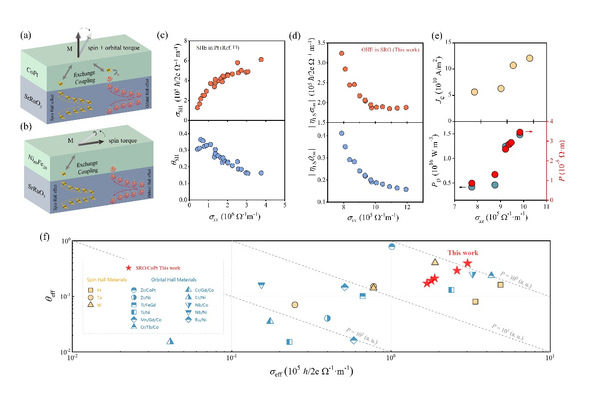
Figure: Unconventional scaling of the orbital Hall effect. (a) Schematic of spin and orbital torque generation in SRO/CoPt. (b) Schematic of spin torque generation in SRO/Py. (c) Scaling of spin Hall conductivity (top) and spin Hall angle (bottom) with conductivity in Pt. (d) Scaling of orbital Hall conductivity (top) and orbital Hall angle (bottom) with conductivity in SRO. (e) Top: critical switching current density of magnetization switching in SRO/CoPt versus SRO conductivity. Bottom: actual switching energy (left axis) and theoretical switching energy measured by second harmonic (right axis) versus conductivity. (f) Effective Hall conductivity and effective Hall angle in SRO/CoPt compared with other spin Hall and orbital Hall materials; dashed lines correspond to different theoretical switching energies.